




The CMO's Stability Problem
How to lead a marketing team when the structure above you keeps changing. A review of the best available evidence, from Wharton to Harvard Kennedy School, on what works. This page is an executive summary of the full report, which is available to download below.
What this report argues
Stop borrowing stability from above. Build it inside.
In 2027, the org chart above you will continue to keep changing. Waiting for it to settle is not a strategy.
The marketing leaders who run high-performing teams through volatility stop borrowing stability from above and build it inside the team instead. A clear direction that doesn't move when the org structure does. Operating norms the team holds regardless of what's happening two levels up. Shared understanding deep enough that everyone can respond coherently to a significant announcement without needing a meeting to work out what it all means first.
This report reviews the best available evidence for how to do that. The frameworks come from serious research: Wharton, Harvard Kennedy School, field studies in high-reliability organisations. The argument underneath them is that in a volatile organisation, the stability your team needs has to come from within. You can't borrow it from the structure above. You have to build it.
Waiting for the organisation to stabilise is not a strategy. Building your team so it doesn't need stability from above is.
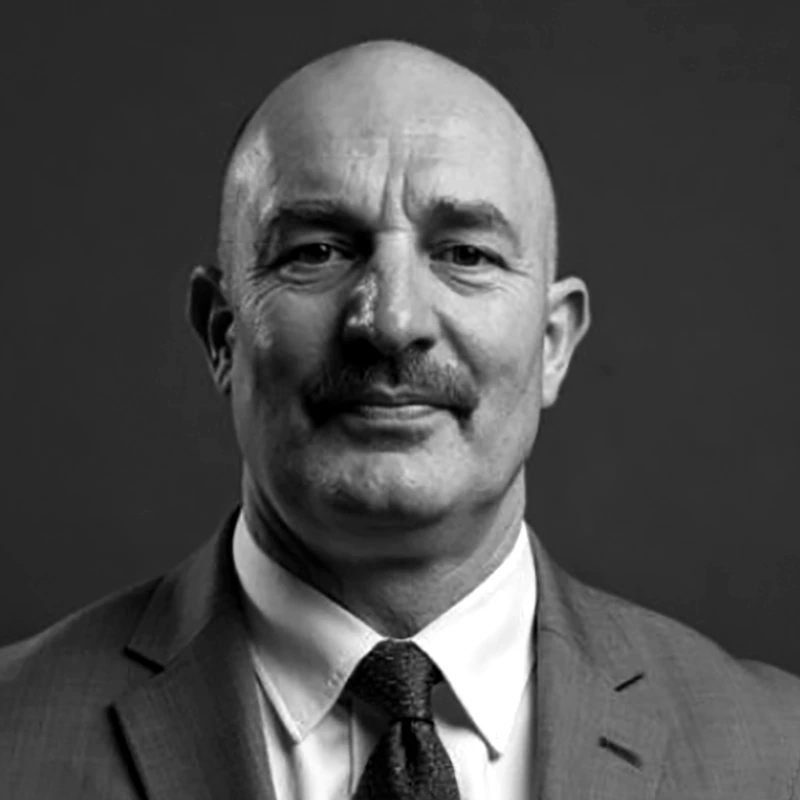
Ian Crocombe · Deft
From the author
I've seen what happens when people stop committing.
I spent four years inside Facebook through five reorganisations. Some of the people I inherited in October 2015 had had eight line managers in twelve months. Nobody was committing to anything. They were watching upward, waiting to see what came next before they moved.
I see the same pattern in the marketing organisations I work with now. When the direction above keeps changing, the instinct is to look upwards: figure out what the senior leader is actually thinking, position ahead of the next restructure, manage up. That instinct costs more than most people realise. It burns focus, clarity and team energy. And it rarely produces what it's supposed to, because senior leaders who are themselves reacting to volatility are by definition not sending consistent signals worth decoding.
In 2026, for marketing leaders in complex organisations, this is probably the most important challenge. It's also a more achievable one than it sounds.
The context
Volatility isn't a phase. It's the operating environment.
Tariffs shift supply chains overnight. Inflation cycles reshape cost structures mid-year. Regulatory changes arrive faster than governance frameworks can absorb them. AI capabilities redraw competitive positions quarterly.
For marketing teams, the pressure is doubled. The macro environment is changing fast, the technology stack underneath the team is changing faster, and the org structure above is being adjusted to keep up with both. A CMO appointed in January is on their third strategic brief by July.
CEOs and boards are responding: they have the broadest purview in the organisation and the most pressure, so they move fast and they change direction. For marketing leaders operating one or two layers below, this creates a specific challenge: how do you build momentum, make good decisions and hold a team together when the direction from above keeps shifting?
This is the new normal. The question is not how to slow the environment down, but how to build a leadership operating model that runs well inside it.
The teams we work with at Deft that navigate volatile environments best are rarely the most senior or the most resourced. They are the ones with the clearest operating norms, the strongest shared understanding of their purpose, and a leader who has stopped waiting for certainty from above before they move. That combination outperforms hierarchy every time.
Ian Crocombe · Deft, from client work 2024-26
What's in the report
Seven principles. Five research frameworks. All of it actionable.
The full report sets out seven principles for how marketing leaders build stability from within their own team. Not generic management advice: each is derived from evidence on what teams that actually operate well inside volatile organisations do differently. Each principle has a name, a rationale and a clear description of what it looks like in practice.
Build stability inside, not from above
Move before the clarity arrives
Separate signal from noise, and agree the filter
Your advantage is your capabilities and relationships, not your position
Run the 20-mile march
Be the buffer
Build shared consciousness
The evidence
The frameworks draw on established organisational research and field studies, not opinion. The core sources behind the report:
- Team of Teams · Stanley McChrystal, 2015. Shared consciousness and empowered execution inside a complex organisation.
- Managing the Unexpected · Karl Weick and Kathleen Sutcliffe, 2015. The academic foundation for high-reliability organisations.
- The Practice of Adaptive Leadership · Ronald Heifetz, Alexander Grashow and Marty Linsky, 2009. Technical versus adaptive challenges.
- Great by Choice · Jim Collins and Morten Hansen, 2011. Wharton-backed research on 10x companies in volatile industries.
- The End of Competitive Advantage · Rita McGrath, 2013. Transient advantage over sustained competitive advantage.
- Why Do So Many Incompetent Men Become Leaders? · Tomas Chamorro-Premuzic, 2019. How confidence gets mistaken for competence.
Download the full report
Get 'The CMO's Stability Problem'
If you'd like a copy of this report, formatted for keeping and sharing with your team, enter your email address to download it.
One email with your download link. Nothing you didn't ask for.
Done. Your download is ready.
Download the report (PDF)About · Working with Deft
Working with Deft
Deft helps CMOs and marketing leaders build the functional capability, across strategy, adoption and operations, to move at a different speed than the organisations around them. We work with your tech, across the full AI programme, and stay until the change sticks.
If your marketing team is navigating structural change, or you can see another reorganisation coming, that's the perfect time, as a leader, to start a conversation with us. We believe that a human, open conversation is the easiest and best place to start.
Ian Crocombe · CEO and founder, Deft · [email protected]